
The Agora as a Court of Public Honor in Acts
 Jason Borges (Ph.D., Durham University) works at the Asia Minor Research Center in Turkey, researching and teaching early Christianity. His latest book, Christian Life in the Greco-Roman City (Baker Academic, 2026), examines how the ancient city shaped the lives and theology of early Christians. A sample of Chapters 1 and 2 can be downloaded here.
Most English translations of the New Testament render the Greek word agora as “marketplace.” While this translation is not incorrect, it is misleading. In ancient Mediterranean cities, the agora was a central town square surrounded by covered porticos. This was not some shopping area but rather a forum for judicial courts. In the public space, honor was contested, shame imposed, and status negotiated.
The term agora originally designated the urban space where Greek citizens assembled to govern. Given the legal proceedings conducted there, agora and its derivatives came to refer to a place of judicial assembly (cf. Acts 19:38). In the Roman era, the town square was the central civic space for the exercise of government and justice. Thus, the Oxford Classical Dictionary defines agora as “an area where people gather together, most particularly for the political functions of the polis.” Yes, buying and selling did happen in the agora, but it was foremost a judicial space where people evaluated and conferred social status.
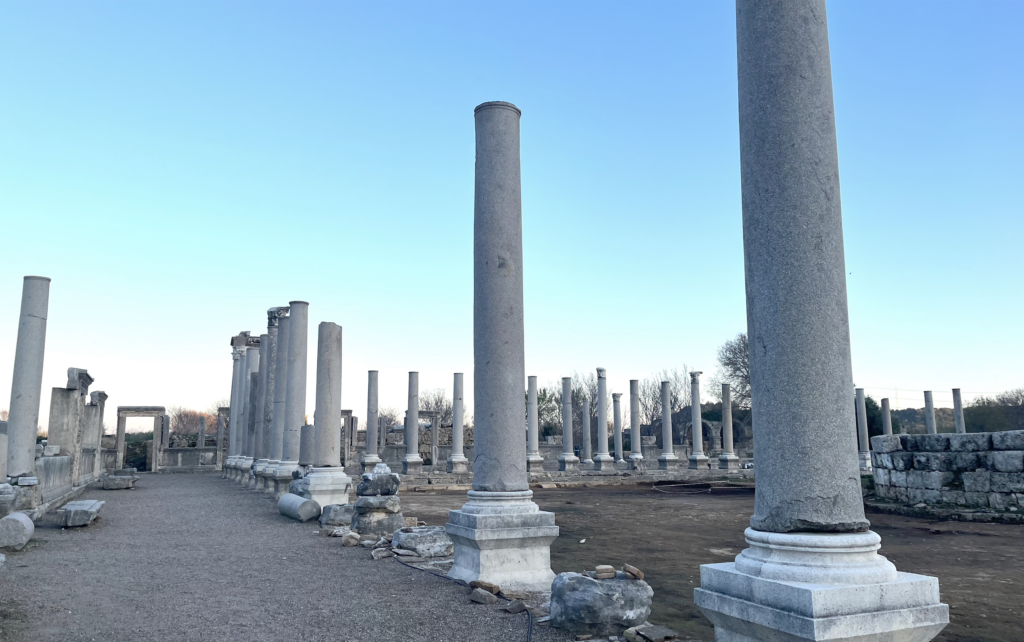
In honor-shame societies, reputation is not formed in private. Identity must be recognized by others and confirmed in public space. For this reason, accusations, judgments, and approvals occurred in a highly visible space, such as the agora. Roman magistrates held court there, civic leaders addressed the populace there, and crowds gathered there to observe and participate in moments of public reckoning.
This social reality helps us interpret the book of Acts. When Acts situates conflict in the agora, it is not merely noting where events happened, as if the agora is a passive backdrop. Rather, the civic setting is drawing readers into scenes of public scrutiny and evaluation.
In Acts 16–18, Paul appears in the agoras of Philippi, Thessalonica, Athens, and Corinth. In each case, he and his associates are publicly accused. These charges function not only as legal claims but also as honor challenges, hence their public nature. Paul is being positioned as socially dangerous and morally suspect before the watching city.
The crowds anticipate the outcome of public shame: punishment, exclusion, or silencing. Yet Acts consistently narrates a reversal. God’s people are released and vindicated. In Philippi, magistrates who publicly beat Paul later apologize and release him. In Thessalonica, civic leaders impose only a minimal penalty before allowing the believers to go free. In Athens, Paul is evaluated by elite authorities yet departs without condemnation and gains adherents. In Corinth, the Roman proconsul refuses to judge the case at all, while the accusers are beaten in full public view. In Acts, the agora setting becomes the place where human judgment is exposed and divine vindication is revealed.
These outcomes are not incidental. Acts presents the agora as a theological space where competing systems of judgment intersect. Roman officials, civic councils, and crowds claim the right to evaluate and condemn. Yet their authority is limited because a higher (divine) court has ultimate jurisdiction. The agora-based narratives in Acts convey Luke’s theology: God is the ultimate and just judge who vindicates his people.
Within the narrative of Luke-Acts, ultimate authority belongs to the risen and ascended Christ. Though not physically present in the agora, Christ functions as the true judge. His own vindication from a Roman death sentence guarantees the vindication of his people. Public accusations may occur, but they do not have the final word upon God’s people.
Reading Acts while paying attention to the honor–shame dynamics of the agora clarifies the stakes of these scenes. Paul is not simply “engaging the marketplace.” He is standing trial in a symbolically charged public court. Acts invites readers to observe these proceedings in the agora and to recognize where true authority lies—the reigning emperor, or the risen Messiah?

resources for Majority World ministry
Leave a Reply