
The Forgiven Debtor Who Loves (Luke 7:41–43)
A certain loan-maker had two debtors—one owed $50,000, and the other owed $5,000. When they had no money to repay, he forgave both of them. So, which debtor would love him more?
Jesus told this short parable after Simon the Pharisee gawked at Jesus for allowing a sinful woman to make an extravagant display of devotion toward him. The parable of the two debtors illustrates that the woman loved much because she was forgiven much, in contrast to Simon.
To address misconceptions and highlight Jesus’ main point, this post analyzes three aspects of the parable in light of honor and shame: the hair, hospitality, and identities.
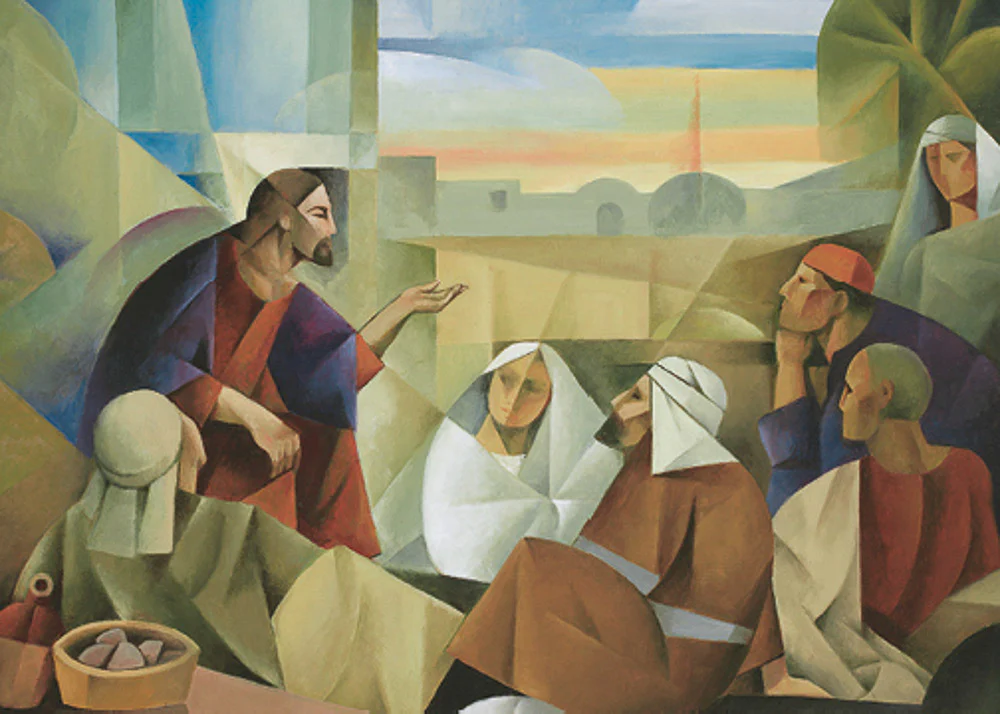
1. The Hair
Verse 38 says the woman wiped Jesus’ feet with her hair. A common interpretation is that such behavior was erotic and shameful. For women, especially “sinful” ones, letting their hair down was a promiscuous act. This reading makes several unwarranted assumptions.
One, the woman may not have been a prostitute. Luke says the woman “was (known) as a sinner in the city.” This could refer to a profession such as that of a sex worker, but it could also mean the woman was an adulterer, or colluded with Gentiles (like a tax collector), or even had a defiling health ailment. The story does not specify the nature of her previous sins, just that they were many, well-known, and, most importantly, forgiven.
Two, in the ancient world, a woman who let her hair down was not necessarily engaging in a sexual act. Hair, along with jewelry and clothes, communicated one’s identity, status, and roles. In general, wearing one’s hair up conveyed a normal, everyday state of being. This hairstyle was the default mode for everyday life. Thus, letting one’s hair down signified a state of disruption and abnormality. The atypical hairstyle conveyed an atypical occasion. To that end, women in the ancient world might let their hair down for mourning and lamenting, religious devotion, ecstatic experiences, and, yes, sexual experiences. (For more, see Charles H. Cosgrove, “A Woman’s Unbound Hair in the Greco-Roman World, with Special Reference to the Story of the ‘Sinful Woman’ in Luke 7:36-50” JBL 124:4 [2005], pp. 675–692.)
The social context makes it highly unlikely that her hairstyle had sexual connotations. She was weeping tears (of gratitude), she was at a dinner party in front of other men, and she had brought an alabaster of expensive myrrh. She was not flirting with Jesus; she was honoring him, even with her hair.
The woman’s use of hair was shocking and disruptive, but not because it communicated erotic sentiments. Rather, it embodied her deep devotion and intense honor toward Jesus. Through her use of tears, myrrh, and even hair, she conveyed profound admiration and gratitude.
In sum, we should interpret the use of hair as a display of honor toward Jesus, not shameful behavior.
2. Hospitality
Meals were central to Jesus’ ministry, not because he was always hungry, but because they communicated worth and defined identity. In this way, meals were an extension of Jesus’ ministry, on par with teaching and healing.
Ritual uncleanness was a big part of Jewish life, especially at meals, when you put things inside your body. At Jewish meals, purity was an utmost priority. The right people had to eat the right food in the right manner, lest they risk ritual defilement and be prohibited from the temple. This explains Simon’s abhorrence of the presence and unseemly behavior of a community-known sinner. Her actions were polluting his event and guests.
Meals also ascribed status. People selected their hosts with an eye toward honor. The events were a way to create an exclusive club, or inner circle. Honor was choreographed down to the seating arrangement. (Jesus, of course, had a few words about this system of status acquisition in Luke 14.)
Furthermore, hosts achieved honor by honoring their guests. (This logic may seem counterintuitive, but remember that the person who honors another must have honor to grant. The ultimate example is God himself—he glorifies/honors us through his status as the source of infinite glory/honor.)
The practice of hosts honoring guests becomes central to the encounter. In his parable, Jesus uses three sharp comparisons (vv. 44–46) to liken the two debtors to Simon and the woman. Each instance follows the same pattern: When I arrived, you did not even do X, yet she did X, Y and Z. Simon failed to extend an ordinary welcome to Jesus, but the woman approached him in an extraordinary manner. Note that she directed her actions toward his feet (not his head or hands) to communicate the extent of her devotion and honor. These public, honorific actions embodied genuine love rooted in divine forgiveness.
The forgiven woman obviously thought highly of Jesus, and she responded accordingly—with great love. Simon, the host, obviously did not, and he responded accordingly—with smug disdain. At several levels, the cultural script of hospitality runs through the encounter.
3. Identity
The question of identity is central to the narrative. Who actually are the woman, Simon, and Jesus? In light of God’s present kingdom, who deserves worth and on what basis? The identities of all three people change from the beginning to the end of the story.
As discussed above, the woman was known as a sinner. The story introduces her as “a sinner in the city,” and Jesus refers to her as having “many sins.” But through some previous encounter with Jesus, she experienced forgiveness and release from her sins and became a different person. She now centers her life upon devotion to Jesus, regardless of circumstances. To erase any doubt, Jesus publicly confirms her new status as forgiven and reconciled before the group of Pharisees.
Simon’s identity also changes, but in the opposite direction. The story repeatedly calls him a Pharisee, which presumes a measure of status and respectability before people and God. But Jesus’ parable paints him as less grateful and less loving toward God than the public sinner. (Note: The fact that Simon was “forgiven less” refers to how he experienced less forgiveness, not that he needed less forgiveness. Moreover, the main point of Jesus’ statement is the paucity of reciprocal love, not initial forgiveness.) The parable forces Simon to reckon, “Am I as pure and right before God as I thought?” Jesus does not denounce Simon, but rather invites him to receive God’s love-generating forgiveness, as the woman did. Like the older son in the famous Prodigal Son parable, we do not know how he responds to the invitation of grace in light of the disruptive challenge.
Jesus’ identity is central as well. Given the nature of Simon’s neglectful welcome, Jesus was a lower-level guest, and his stock dropped even more when the woman approached him. Simon thought, “How can this guy be God’s prophet if he doesn’t know who this woman is?” Jesus quickly shows that he is a prophet; he knows Simon’s inner thoughts, teaches with authority, and announces forgiveness. Jesus proclaims the reality of God’s forgiveness. Those at the meal ask, “Who is this?” They are confused about Jesus’ identity, but the informed reader is not. As the means of forgiveness, Jesus represents the arrival of God’s Jubilee, the messianic era, and a new temple. He embodies the arrival of God’s kingdom through his acts of forgiving welcome.
In sum, at public meals, Jesus’ forgiveness prompts extravagant devotion from a sinner/debtor, which reveals the true identity of each person involved.

resources for Majority World ministry
As always, most insightful article!!!
Thank you very much. This was insightful indeed. I have looked up the article from Cosgrove. This is helpful.
It is worth seeing the story in the wider context as well. In 7:29-30 we see that the sort of “sinners” were willing to be baptized, the Pharisees and Scribes though not. They despised it, which means they felt it was not necessary for them. This fits perfectly with the story.
After the story Luke briefly mentions that other women followed and served Jesus. They had been healed and received exorcism. They were probably ostracised as well.
Just loved the fact ,that Jesus was mindful of everyone in the room ,this also shows the dynamics of Jesus not condemning but inviting. A lovely thought provoking dynamics .thanks